Bachelor of Arts in Music
Program Overview
Bellarmine’s Bachelor of Arts in Music provides comprehensive training in performance, scholarship, and the practical aspects of the music profession. Blending traditional and contemporary music study, preparing students for careers in performance, composition, music technology, and other music-related fields. Students develop their skills through rigorous coursework, ensemble participation, and individualized instruction that supports both artistic growth and professional development.
The flexible structure of the degree also allows students to double-major or explore other academic interests while continuing to develop as musicians.
Why Study Music at Bellarmine?
Study music in a supportive environment while gaining real-world experience in one of the region’s most vibrant arts communities. Bellarmine students learn from faculty who are at the heart of the local music scene actively performing, conducting, composing and educationg. Their professional work and connections bring real-world insight, mentorship, and opportunities directly into the classroom and rehearsal space.
Located in Louisville’s thriving arts community, students benefit from performances, collaborations, and internship opportunities throughout the city, expanding their experience beyond campus. Majors within the Music Department include:
- Vocal Performance
- Instrumental Performance
- Piano Pedagogy and Accompanying
- Jazz Studies
- Theory/Composition
- Music Technology
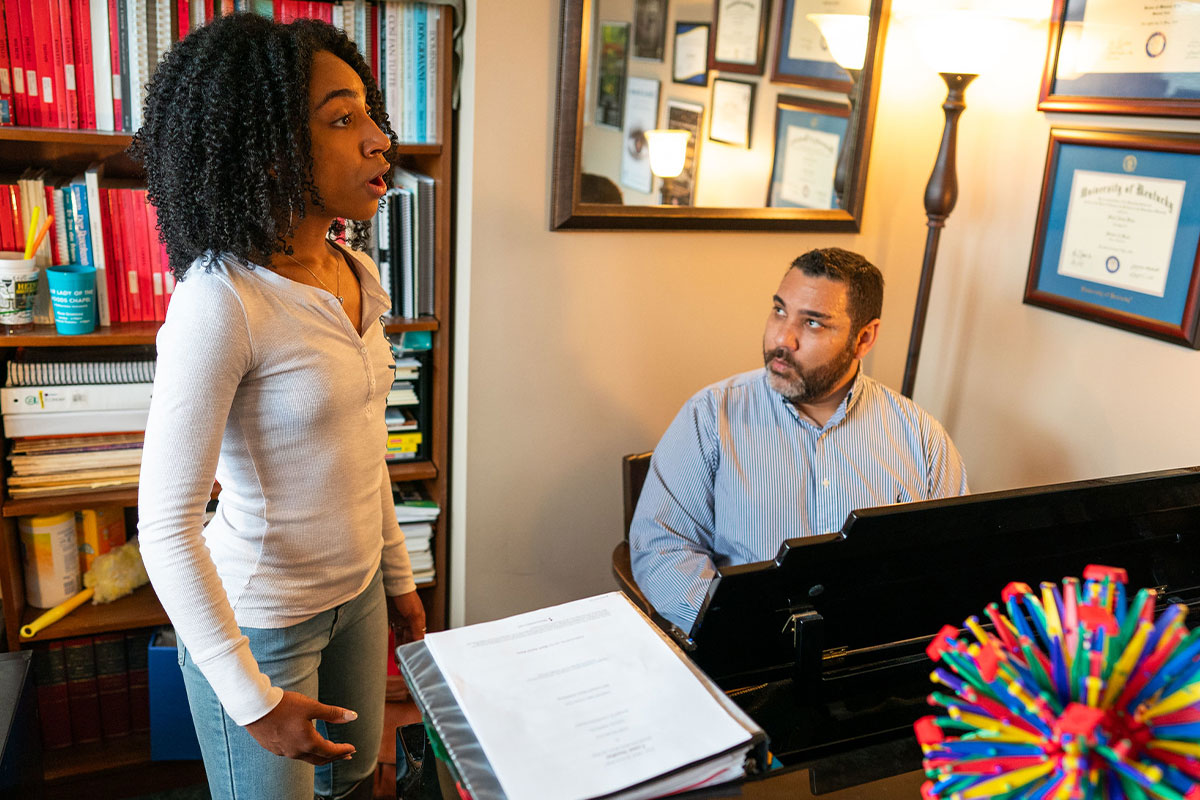
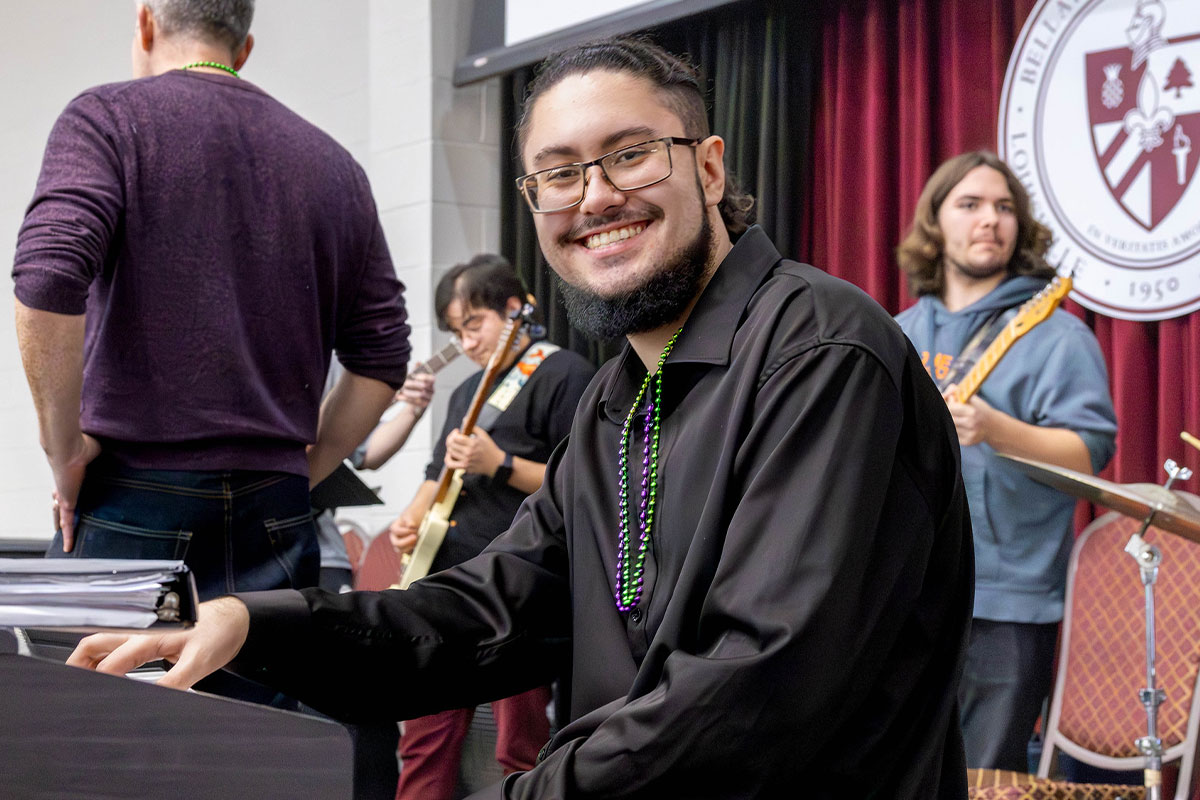
Integrated Training for Today’s Musicians
Study performance, scholarship, and the practical aspects of the musical profession in an inclusive, engaging environment. Prepare for diverse pathways including performance, conducting, composing, music education, and electronic music.
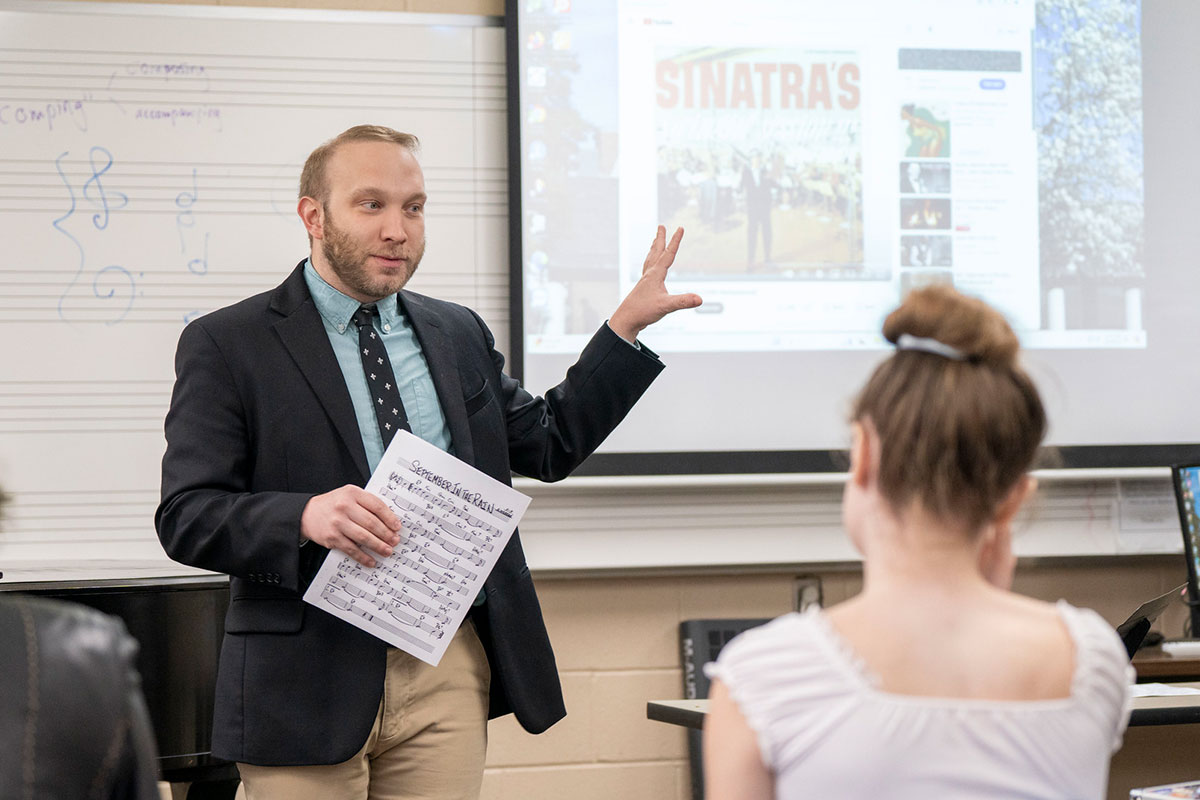
Learn from World-Renowned Music Faculty
Students benefit from the vibrant Louisville music scene while receiving individualized attention at Bellarmine. Learn from faculty who are active performers, conductors, educators, scholars, and composers, bringing real-world industry experience into the classroom and ensemble.
"Professionally, we're learning a lot of music-related things in this program and obviously getting better at our craft. We're constantly doing new things and performing new places. Building connections is really a big thing in the professional world of music, and that is definitely a big thing in this program."
Evan Bullock '27, Vocal Performance and Music Technology
50+
Study Abroad Opportunities
12:1
Student-to-Faculty Ratio
6
Applied Music Majors
What courses are required to complete the program?
Bachelor of Arts in Music:
- MUSC 101, 102, 105, 110, 201, 205, 211, 330, 409, 410;
- MUSI 191 (eight semesters);
- Eight credits (one per semester), in applied major (MUSI instrument, vocal, or jazz course);
- Eight credits (one per semester) of an approved ensemble (MUSE course);
- Four credits of approved upper level music (MUSC) electives.
Bachelor of Arts Music majors must also complete six credits of a foreign language or satisfy the Bellarmine College of Arts and Sciences Bachelor of Arts foreign language proficiency requirement.
Bachelor of Music, Emphasis in Instrumental Performance, Jazz Studies, Piano Pedagogy & Accompanying, Theory & Composition, or Vocal Performance:
- Required Music Theory Courses: MUSC 101, 102, 105, 201, 202, 205, and 206;
- Required Music History Courses: MUSC 211, 330, and 409;
- Additional Required Music Courses: MUSC 110, 320; 434;
- Eight credits of upper level music (MUSC) electives;
- Eight credit hours of emphasis courses (see Required Emphasis below).
- Required Performance Courses: MUSI 191 (eight semesters); MUSC 210, 310, 410;
- Sixteen credits in applied music (two credit hours per semester of the same applied MUSI course appropriate to the emphasis);
- Eight credits of an approved ensemble (1 credit hour MUSE course per semester).
- Required Emphasis - All BM majors must select one of the following major emphases and complete the required courses for that emphasis:
-
- Instrumental Performance Emphasis: MUSC 341, 405, 407, and 420.
- Jazz Studies Emphasis: MUSC 312 and 343, and 4 hours of MUSI 201.
- Piano Pedagogy and Accompanying Emphasis: MUSC 266, 354, 355, and 366.
- Vocal Performance Emphasis: MUSC 351, 375, 385, 412, and 420.
- Music Theory and Composition Emphasis: MUSC 341, 403, 405, and 407.
Bachelor of Music, Emphasis in Music Technology:
- Required Music Theory Courses: MUSC 101, 102, 105, 201, 202, 205, and 206;
- Required Music History Courses: MUSC 211, 330, and 409;
- Additional Required Music Courses: MUSC 110, 304, 341, 407, 434; and eight credits of upper level music (MUSC) electives.
- Required Performance Courses: MUSI 191 (eight semesters), MUSC 410, eight credits in applied music (1 credit hour MUSI course per semester), and four credits of an approved ensemble (1 credit hour MUSE course for four semesters).
- Required Music Technology Emphasis Courses: MUST 173, 174, 273, 274, 373, 374, 380, 473, 474.
Are there any special admission requirements for this degree program?
In order to be accepted into the Music Program as a major or minor, you must successfully
complete an entrance audition. This audition can be set up at various times throughout
the year based upon your planned visit to the Bellarmine campus. The audition will
not deny you entrance; it is designed to allow faculty members to assess your music
skills and background so they may better advise you as to the most suitable degree
track and course schedule for your individual situation.
Successful completion of the course requirements for the degree and consistent improvement of your musical skills are necessary to remain in the major or minor status.
What employment opportunities are available with a degree in music?
Some of our graduates have gone on to teach in public and private schools. Others
have completed graduate degrees in music at the University of Kentucky, University
of Louisville, New York University, University of Maryland, or other graduate degrees
at the Savannah College of Art and Design and Minnesota State University in fields
including Music Therapy, Special Education, Chiropractic School, and Experiential
Education. Other graduates go on to careers in Studio Recording and Engineering as
well as successful freelance musicians, private studio teachers, and composers living
and working in Louisville, New York City, Pittsburgh, Nashville, and Los Angeles.
Do you provide job or internship placement?
Yes. Students in the Music Program are required to complete an internship to gain
first-hand experience from professional organizations. Bellarmine students take advantage
of internship opportunities at a number of music- and arts-related venues in the Louisville
Metro area. Some of those include Gist Piano Technician and Marketing Training, Label
X, WFPK/WFPL Radio Partnership, Kentucky Center for the Performing Arts, Actors Theatre
of Louisville, Arts Council of Southern Indiana, StageOne Children’s Theatre, and
TNT Recording Studio.
Is financial aid available?
Yes. Please go to Bellarmine’s financial aid website for detailed information on financial aid packages. Additionally, students can work
with our Faculty Development Center to apply for grants and awards outside of the
Bellarmine offerings.
How many hours can I expect to spend studying outside of class time?
Students have their own learning styles so this can vary greatly. As a rule of thumb,
expect to spend an average of two hours studying for every hour you spend in class.
The Music Department does not deny anyone the opportunity to participate in our music program. If you wish to be accepted into the music program as a major or minor, you must successfully complete an entrance audition. This audition can be set up at various times throughout the year based upon your planned visit to the Bellarmine campus. The audition is designed to allow the faculty members of the music department to assess your music skills and background so that we may better advise you as to the most suitable degree track and course schedule for your individual situation. Successful completion of the course requirements for the degree and consistent improvement of your musical skills are necessary to remain in the major or minor.
Write and record your own music. Learn on-site and studio recording skills and how to build an effective home digital recording studio. Learn basic digital manipulation and editing techniques through synthesis, signal processing, software-based systems, and interactive computer music, acoustics, perception, basic electronics, invention, trends, aesthetics and the history of electro-acoustic music. Learn aspects of the music business including Intellectual Property, Copyright and Artist Contract Laws. All music technology majors will be accepted into the program upon successful completion of an interview with the program director, a music portfolio/audio CD, and instrumental or vocal audition. If you do not have a music portfolio, this does not mean you cannot enter the program—call the department chair and he will further explain.
Music majors have opportunities to use state-of-the-art equipment to study current music technology and studio recording skills, and can participate in performances with other students. With performing arts productions from the art, music and theatre departments, students can attend a number of out-of-the-classroom events and engage with students from in and outside the major. Music majors make the most of their learning experience by learning from students, faculty and performing arts professionals who are invited to campus to share their productions and experiences with students.
Ensembles
We offer intensive ensembles for experienced music majors and a variety of ensemble
opportunities for non-majors. Ensembles include University Singers, Schola cantorum,
Men’s Choir, Women’s Choir, Brass Choir, Chamber Winds, Chamber Strings, Classical
Guitar Ensemble, Flute Ensemble, Handbell Ensemble, Jazz Combo, Nouveau Gumbo Ensemble,
Opera Theater, Percussion Ensemble, Piano Ensemble, Symphonic Wind Ensemble, Technology
Ensemble, Trumpet Ensemble, and African Drum Ensemble.
Some of our graduates have gone on to teach in public and private schools. Others have completed graduate degrees in music at the University of Kentucky, University of Louisville, New York University, University of Maryland, or other graduate degrees at the Savannah College of Art and Design and Minnesota State University in fields including Music Therapy, Special Education, Chiropractic School, and Experiential Education. Other graduates go on to careers in Studio Recording and Engineering as well as successful freelance musicians, private studio teachers, and composers living and working in Louisville, New York City, Pittsburgh, Nashville, and Los Angeles.
Contact
Mark Kano, Ph.D.
Fine Arts & Communication Division Chair
mkano@bellarmine.edu
502.272.8345
Take Your Next Step
Start your Bellarmine story. Request information today.
Request InformationCome to campus and see what Bellarmine hospitality is all about.
Schedule Your Visit