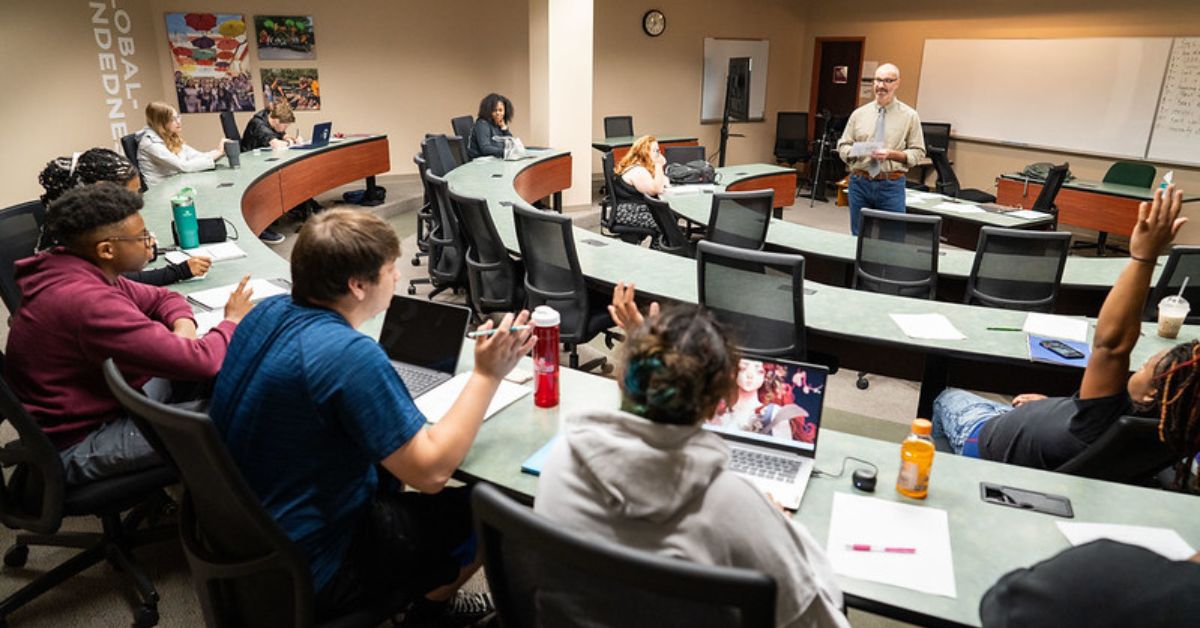
More than 40 incoming students are on Bellarmine’s campus this summer for a new program,
Bridge to BU, that aims to prepare them for success during the rest of their college experience.
The 42 students, who have been conditionally accepted to Bellarmine, moved into a
residence hall on July 5 for the four-week college-readiness program, which runs through
Aug. 4.
During Bridge to BU, they are taking three courses worth seven credit hours total:
English 100 (3), Math 100 (3) and BU 101, a one-credit-hour course that focuses on
core tools for academic success, such as how to take good notes, how to reach faculty
outside of class and how to understand academic credits. They’ll also connect with
all the student-support offices on campus, such as the Tutoring Center, the Writing Center and the Accessibility Resource Center, and enjoy social activities on and off campus.
Upon successfully completing the program, the students will receive full admission
to Bellarmine and be eligible to enroll in classes for the fall of 2023. The university
will continue to provide support, such as extra meetings with their advisors.
“The goal is that they have that sense of belonging, that connection to our community,
that connection to each other, which we know is going to increase their chances of
succeeding in the fall,” said Dr. Jon Blandford, an associate professor of English
and the head of Bellarmine’s Honors Program, who helped to develop the courses and
is directing Bridge to BU.
Dr. Mike Marshall, Bellarmine’s vice president for Enrollment, Marketing and Communication,
was a key proponent of the summer bridge program. He noted that the traditional college-age
population is both shrinking and shifting.
“The latter is resulting in a more pluralistic pool of students, many of whom have
been historically underrepresented and underserved in both K-12 and higher education
spaces,” he said. Combined with this is the fact that the pandemic exacerbated learning
loss and social and emotional development. “For example, we hear about reports of
math and reading test scores dropping to their lowest levels in decades.”
Enter Bridge to BU.
“Bridge to BU is focused on expanding the diverse talent pipeline and creating culturally
responsive systems to meet students where they are in their academic and personal
journey,” Marshall said. “This is important to Bellarmine as we remain laser-focused
on increasing access and affordability as well as preparing career and life-ready
graduates. The program also aligns with Bellarmine’s cura personalis philosophy—care for the whole person.”
A review of other schools offering bridge programs showed that more than 80 percent
of the participating students successfully entered the following term, he said. And
those students who received additional support, such as Bellarmine plans to provide,
were more likely to come back the following year.
Bridge to BU, which is free to students, is being paid for with two grants: a one-year
commitment of $50,000 from the Kentucky Council on Postsecondary Education and a three-year
commitment of $150,000 ($50,000 per year) from the C.E. and S. Foundation.
The three courses the Bridge to BU students are taking are brand new, designed specifically
for the program, Blandford said. There will be little to no lecturing; instead, students
will have four weeks of hands-on practice.
The English class is focused on the fundamentals of college writing. “We want to give
them the basic building blocks, which we sometimes take for granted,” he said. “How
does a thesis shape a paper? How do you effectively organize a paragraph? How do you
signal transitions between ideas using topic sentences?”
Similarly, the math class, a quantitative literacy course, will cover topics like
reasoning, logic and systematic thinking, which will be useful no matter what mathematics
classes the students will take for their majors, he said. The course will also employ
ALEKS, a software program that adapts to each student’s level of mastery. “I think
it’s really cool that we can provide this tailored, customized, targeted educational
experience for these students,” Blandford said.
Natalie Cousin, Bellarmine’s assistant director of Strategic Enrollment Partnerships,
is teaching BU 101, the academic success skills class. She said she was happy to see
signs of engagement within her group of students by the second week of classes—not
just with each other, but also with campus resources and staff.
“And then I overheard a student talking about helping another student get a job for
the fall,” she said. “It was great to see them connecting with each other.”